When someone discovers your blog through a search engine, the first thing they often see is not the article itself. Instead, they see a search result containing a title and a short description.
That description can influence whether a person clicks your page or chooses another result.
For Blogger users learning search optimization, one of the simplest improvements is adding custom meta descriptions to posts. These descriptions help provide context about a page and can improve how content appears in search results, social previews, and other discovery platforms.
This guide explains what meta descriptions do, how to add them in Blogger, and how to write descriptions that help both readers and search engines understand your content.
What Is a Meta Description?
A meta description is a short summary of a page’s content.
It is stored within a page’s metadata and is commonly used by search engines to generate search result snippets.
A typical meta description:
- Summarizes the page
- Explains the topic
- Encourages clicks
- Provides context before a visitor opens the page
For example, a search result may display:
Title:
How to Add Meta Descriptions to Blogger Posts
Description:
Learn how to create custom meta descriptions in Blogger to improve search snippets, social previews, and content discoverability.
This summary helps users decide whether the page is relevant to their needs.
Why Meta Descriptions Matter
Meta descriptions do not directly determine search rankings, but they can influence how searchers interact with your content.
Good descriptions help:
- Improve search result appearance
- Clarify page topics
- Encourage clicks
- Support content discovery
- Improve user expectations
Better snippets help searchers understand why your page matters before they visit it.
Understanding Search Snippets
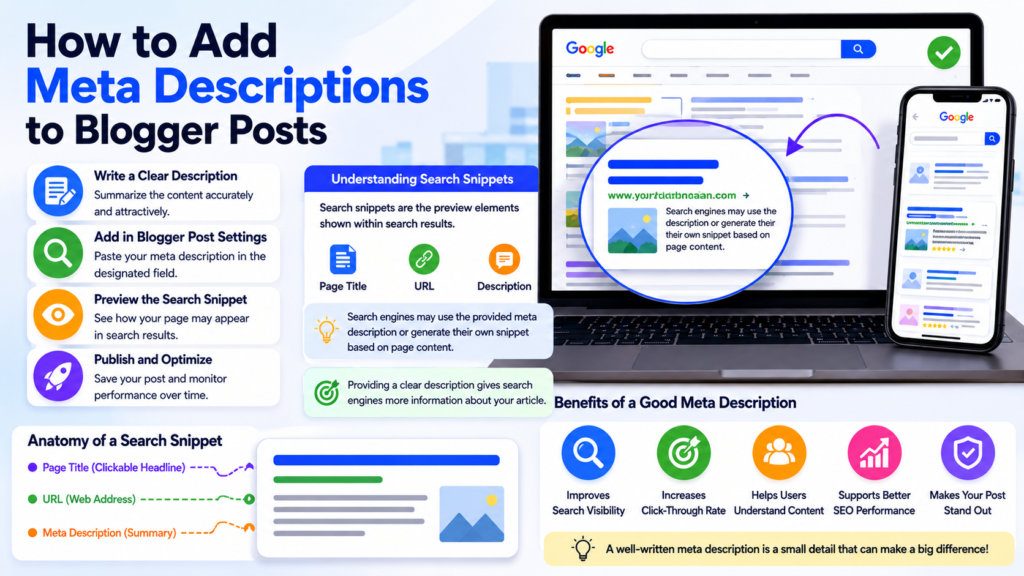
Search snippets are the preview elements shown within search results.
A snippet typically includes:
- Page title
- URL
- Description
Search engines may use the provided meta description or generate their own snippet based on page content.
However, providing a clear description gives search engines more information about your article.
Learning how descriptions influence search snippets is one of the first steps toward improving content visibility.
Meta Descriptions in Blogger
Blogger includes built-in tools for managing metadata.
Users can create:
Site-Level Descriptions
A description for the entire blog.
Post-Level Descriptions
Custom descriptions for individual articles.
Post-level descriptions are generally more valuable because they provide specific context for each page.
How to Add a Meta Description to a Blogger Post
Adding descriptions in Blogger is straightforward.
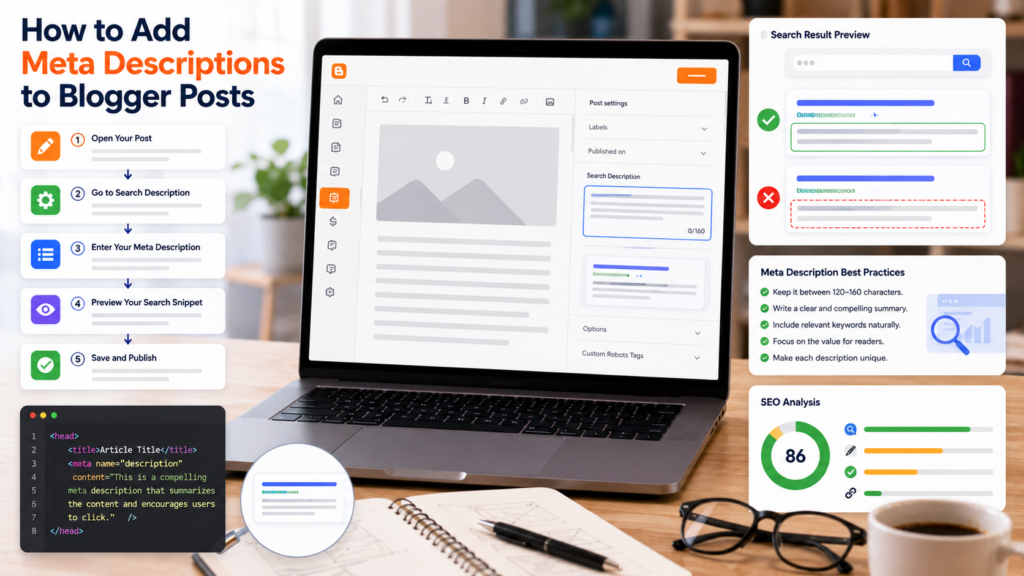
Step 1: Open Blogger
Log in to your Blogger dashboard.
Step 2: Create or Edit a Post
Open an existing article or begin writing a new one.
Step 3: Locate the Search Description Option
Within the post settings area, look for the Search Description field.
Step 4: Write a Relevant Summary
Create a concise description that explains what readers will learn.
Step 5: Save and Publish
Save your changes and publish or update the article.
The description is then included within the page metadata.
Writing Better Meta Descriptions
Good descriptions focus on helping readers understand the page.
Explain the Topic Clearly
Readers should immediately understand what the article covers.
Match Search Intent
Describe the information users are likely seeking.
Keep It Concise
Short, focused descriptions are generally easier to read.
Avoid Keyword Stuffing
Descriptions should sound natural rather than repetitive.
Highlight Value
Explain why the content is useful.
These principles are fundamental blog SEO settings that every Blogger user should understand.
Example Meta Descriptions
Tutorial Article
Learn how to create custom meta descriptions in Blogger and improve search result previews.
SEO Guide
A beginner-friendly guide to metadata, search snippets, and Blogger SEO optimization.
Publishing Article
Discover how metadata helps search engines, social platforms, and readers understand your content.
Notice that each example focuses on clarity rather than excessive keyword usage.
Common Mistakes
Missing Descriptions
Many Blogger posts are published without custom descriptions.
Duplicate Descriptions
Every page should have its own unique summary.
Overly Generic Text
Descriptions should accurately reflect page content.
Keyword Stuffing
Excessive repetition creates poor user experiences.
Misleading Information
Descriptions should set realistic expectations.
These issues can reduce the effectiveness of metadata and create confusion for readers.
Beyond Search Engines
Meta descriptions influence more than traditional search results.
Metadata may also affect:
- Social media previews
- Content sharing platforms
- Messaging applications
- Browser previews
- AI-generated content summaries
As digital publishing evolves, metadata will continue supporting content interpretation across multiple platforms.
Building Better Blogger SEO Foundations
Meta descriptions are only one part of a broader optimization strategy.
Successful bloggers also focus on:
- Clear titles
- Organized content structure
- Internal linking
- User experience
- Content quality
For additional guidance, explore our collection of SEO for bloggers, review practical blog SEO settings, and learn how search engines generate effective search snippets across different types of content.
Frequently Asked Questions
Do meta descriptions improve rankings?
Meta descriptions are not considered a direct ranking factor, but they can influence click-through behavior.
How long should a meta description be?
Descriptions should be concise and focused while accurately describing the page.
Does Blogger support custom meta descriptions?
Yes. Blogger includes a Search Description feature for individual posts.
Can search engines ignore my description?
Yes. Search engines sometimes generate alternative snippets when they believe another section of the page better matches a query.
Should every post have a meta description?
Ideally, yes. Unique descriptions provide better context for readers and search engines.
Final Thoughts
Adding custom meta descriptions to Blogger posts is one of the simplest ways to improve how content appears across search engines and discovery platforms.
While descriptions may not directly influence rankings, they help readers understand what a page offers and can improve the overall quality of search result previews. Combined with strong content, thoughtful metadata contributes to a better publishing experience for both creators and audiences.
As search, social sharing, and AI-assisted browsing continue evolving, well-written metadata will remain an important part of effective content publishing.